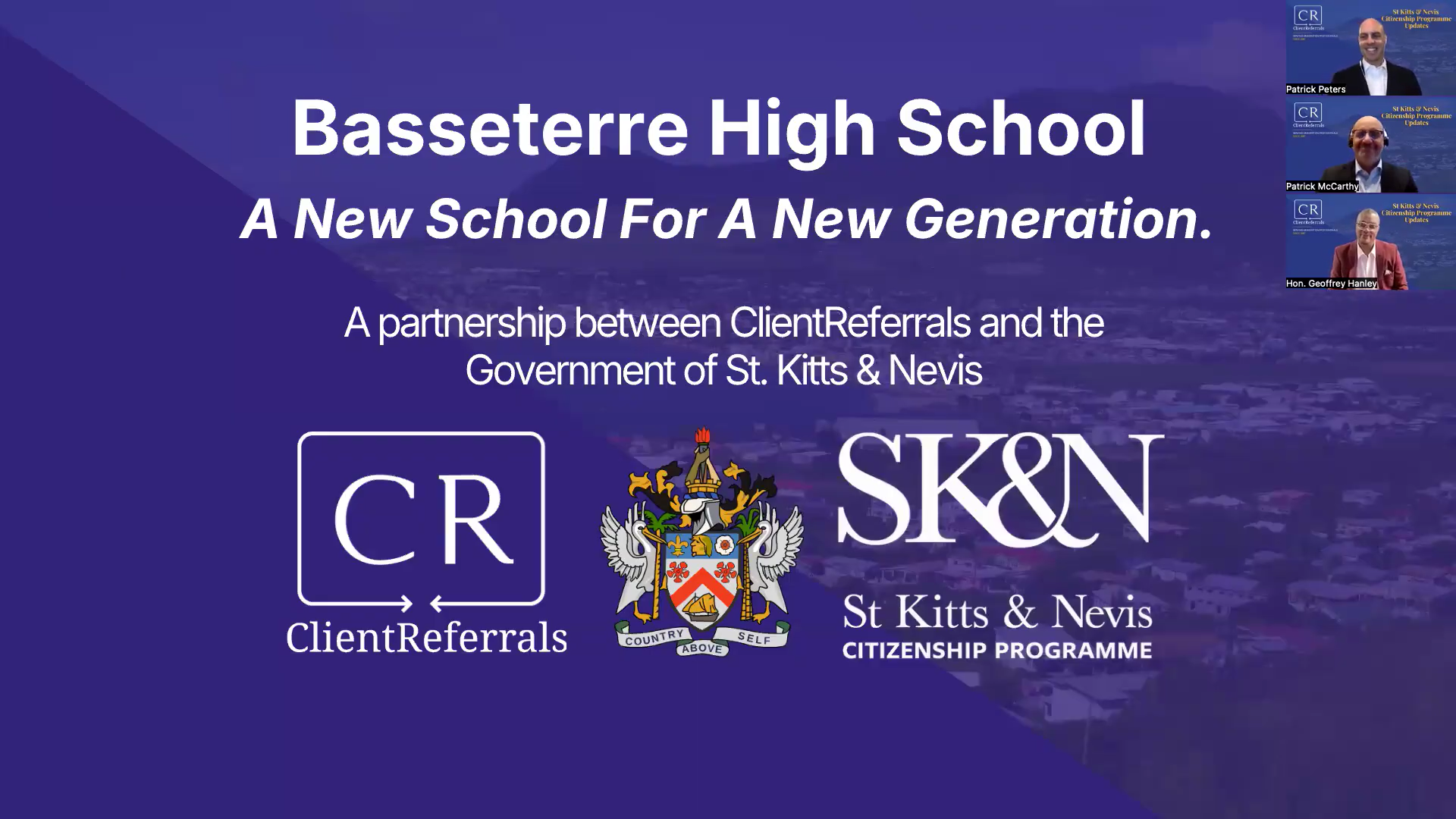
ClientReferrals recently hosted an exclusive webinar bringing together industry professionals from around the world for a discussion on the latest developments in the St. Kitts and Nevis Citizenship Programme.
Patrick Peters, CEO of ClientReferrals, was joined by the Hon. Dr. Geoffrey Hanley, Deputy Prime Minister of St. Kitts and Nevis and Minister responsible for Education and Housing, and Patrick McCarthy of ClientReferrals.
The discussion covered developments across the Citizenship Programme, including the Public Benefit Option (PBO), progress on the Basseterre High School and National Housing Corporation projects, recent price harmonisation, changes affecting dependent family members, the biometric rollout and the evolving relationship between Caribbean citizenship programmes and international partners.
Citizenship by Investment With a Visible Impact
A significant part of the conversation focused on what Citizenship by Investment can deliver for the people of St. Kitts and Nevis.
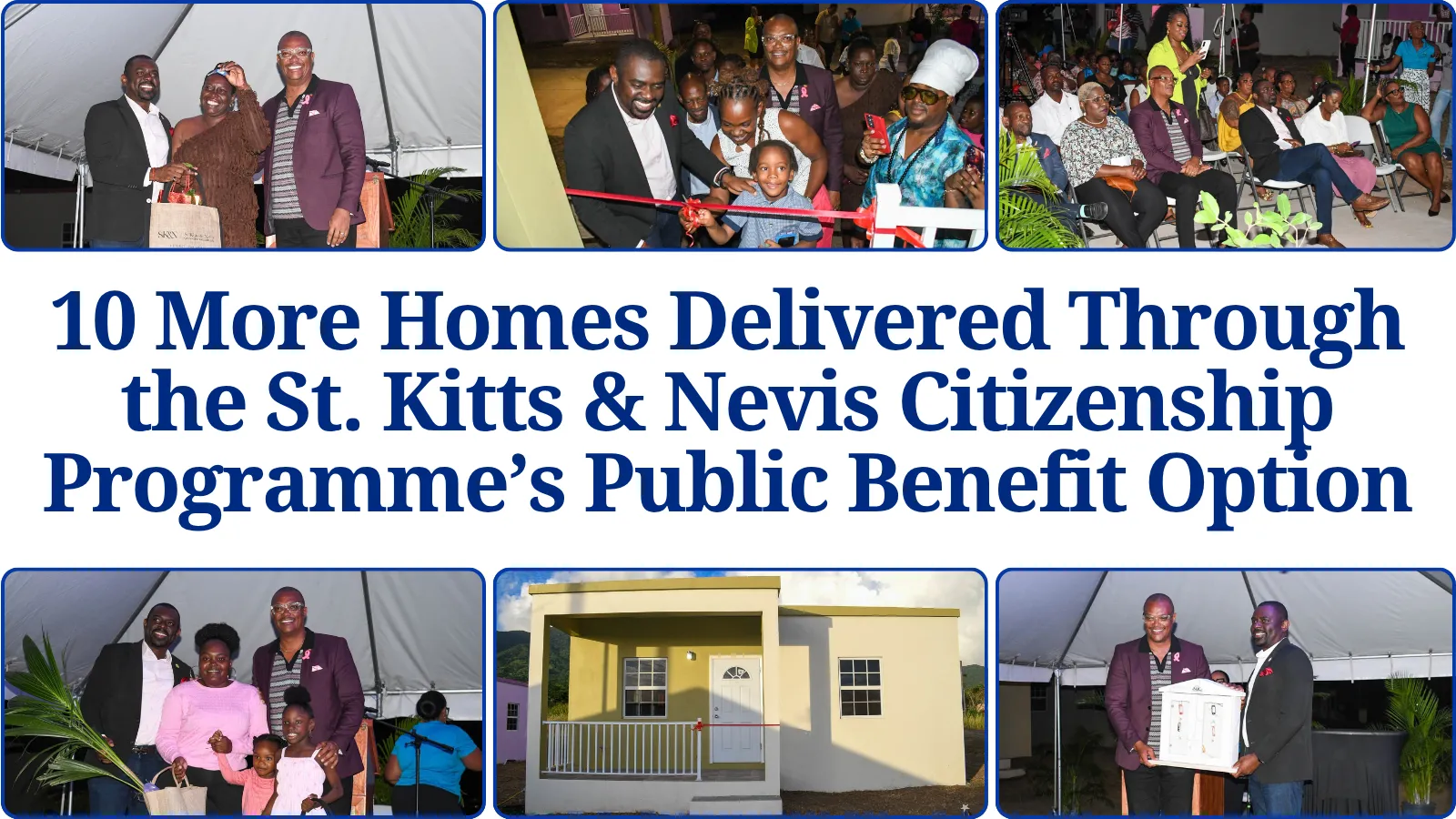
Deputy Prime Minister Hanley discussed two initiatives supported through ClientReferrals: the National Housing Corporation’s affordable housing initiative and the reconstruction of Basseterre High School.
The NHC initiative is already supporting the construction of more than 100 homes for families across St. Kitts. During the webinar, Dr. Hanley also shared his own connection with affordable housing, recalling how his mother benefited from an NHC home in 1997 and explaining the role home ownership can play in dignity, opportunity and generational wealth.
For ClientReferrals, these outcomes also demonstrate why the projects selected under Citizenship by Investment matter. In his history in the RCBI industry, the team behind ClientReferrals has always prioritized the delivery of its projects, ensuring a Win-Win-Win concept where the host nation gets the economic impact delivered by the investment, the applicants get their immigration status, and private industry benefit from bringing the transaction to life. All three parties must win for a program to be successful in the short and long term.
Basseterre High School Moves From Plans to Construction
The reconstruction of Basseterre High School was one of the central themes of the webinar.
Dr. Hanley spoke both as Minister of Education and as an alumnus and former educator, describing the importance the institution holds for generations of Kittitians.
Students have been without a permanent Basseterre High School campus for more than 12 years. The new school is intended to change that with a modern, resilient campus designed to accommodate approximately 800 to 900 students.
Plans discussed during the webinar include 32 classrooms, science and technical laboratories, modern language facilities, an auditorium, gymnasium, library, athletic track, vocational spaces, interactive classroom technology and sustainability features.
Construction is now visibly progressing. Recent images shared during the webinar showed precast wall panels being installed, with the project reported to be progressing according to plan,clearly a government priority.
Reflecting on what the project could mean beyond the construction itself, Dr. Hanley told attendees that “generations will benefit” from the investment being made today.
PBO and SISC Pricing Now Harmonised
The webinar then turned to one of the most recent changes to the Citizenship Programme: the harmonisation of the Public Benefit Option and Sustainable Island State Contribution cost structures.
The change was approved in July and became effective on August 1, 2026.
As explained during the webinar, the two options now mirror one another in terms of pricing. For families of up to four, post-approval government fees are incorporated into the contribution amount, with additional fees applying from the fifth family member onward.
The discussion went beyond pricing itself. The speakers considered what harmonisation may signal about the continuing role of the PBO within the Programme, particularly as governments and international partners increasingly discuss concepts such as genuine links and connections between applicants and host countries.
While the precise future evolution of the PBO remains uncertain, the webinar noted that the Government's decision to harmonise pricing demonstrates the continuing importance being placed on the option and its impact within St. Kitts and Nevis.
More Flexibility for Families
Recent changes to the definition of eligible dependants were also discussed.
Dependent children can now be included up to age 29, provided the application is submitted before their 30th birthday, while the previous requirement for those children to be enrolled in full-time education has been removed.
The qualifying age for parents has also been reduced from 65 to 55, while the previous requirement that qualifying parents live with the principal applicant and spouse has been removed.
Together, the changes provide greater flexibility for families considering an application.
Biometrics: What Partners and Existing Citizens Need to Know
The rollout of St. Kitts and Nevis' national biometric enrolment and passport modernisation programme generated significant discussion.
The programme launched on April 14, with biometric collection beginning on May 1. Citizens who obtained citizenship through the Citizenship Programme are required to complete biometric enrolment by July 31, 2027, ahead of the planned deactivation of existing regular passports for international travel from August 1, 2027.
The webinar also discussed the expanding international network of biometric collection locations and the Government's efforts to make enrolment accessible to citizens living around the world.
The broader significance, however, goes beyond the practical process. The biometric initiative was presented as part of St. Kitts and Nevis' response to the expectations of international partners and its effort to align identity verification and border security with international standards.
What Comes Next for Caribbean Citizenship Programmes?
One of the most closely followed parts of the webinar concerned the European Union, potential residency requirements and the future direction of Caribbean Citizenship by Investment.
Rather than presenting the issue as a choice between programme closure and the loss of visa-free Schengen access, the discussion emphasised that the eventual outcome remains uncertain and could be considerably more nuanced.
St. Kitts and Nevis has been engaging with international partners and has already implemented significant reforms. The webinar noted that the five Caribbean CBI jurisdictions had submitted coordinated responses to the EU, with further dialogue expected.
At the same time, change should be expected.
The discussion anticipated that Caribbean programmes could become more restrictive over the coming years, with areas such as residency requirements, regional regulation, movement of funds, source-of-funds documentation and eligibility potentially continuing to evolve.
For industry professionals, the important point is not to react to every headline, but to understand that tge best time to apply is now before programs become less accessible..
Continuing the Conversation
The webinar generated a wide range of questions from professionals around the world, from family eligibility and biometrics to marketing requirements, the PBO and the future regulatory direction of Caribbean Citizenship by Investment.
If you weren't able to listen in, please contact us to discuss what we learned from the webinar and what the latest developments could mean for you and your clients.